Sunday, 11 May 2014

Green Again


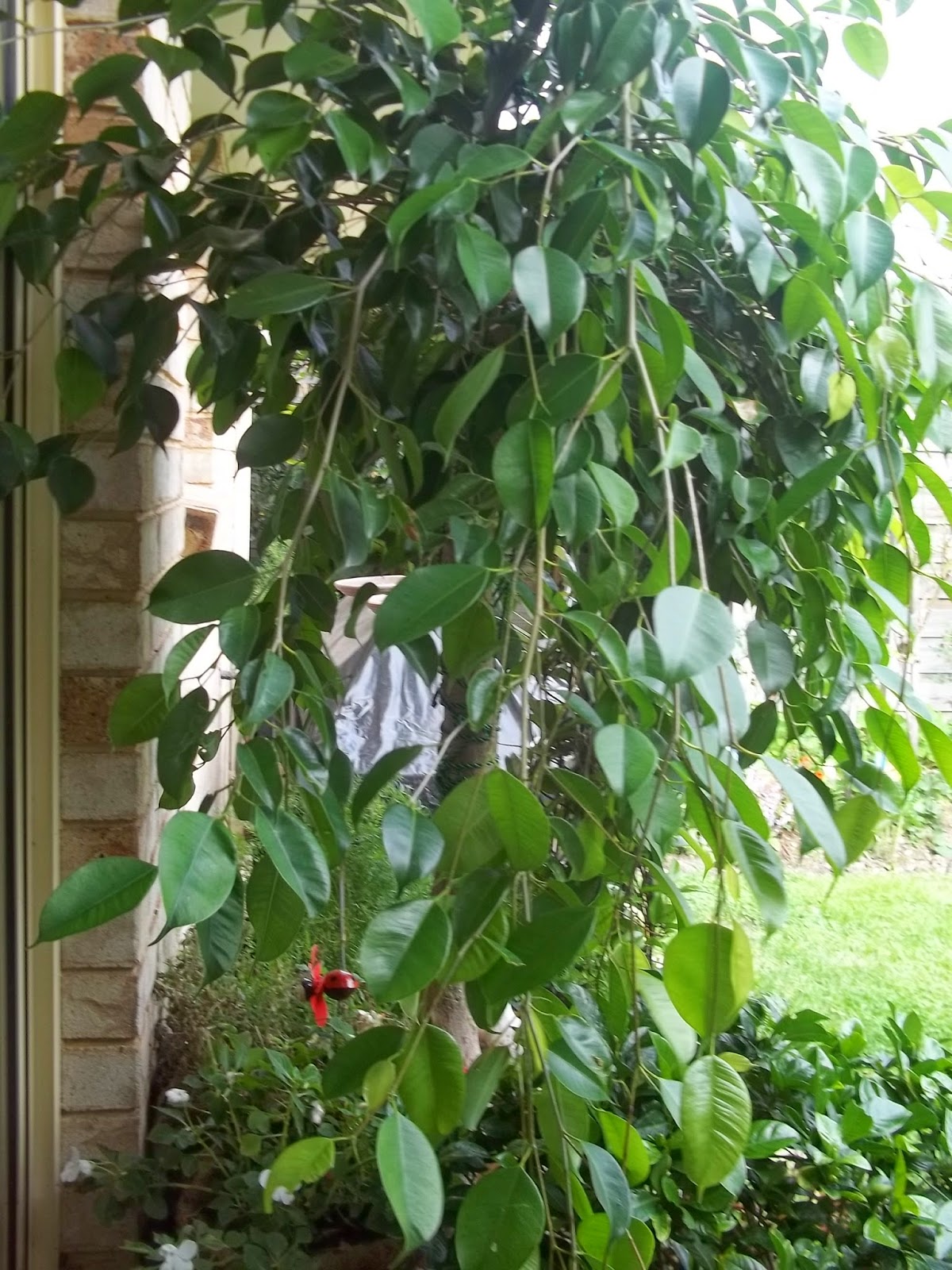
The rain, generous rains bring back my garden to life, it is green again.  The grass, the shrubs, the topiary, the pines are all lush and leafy, and also my potted plants are so green.  The weeping fig's leaves are weeping, cascading to the ground showing off its colour, shiny light and dark green, it is so beautiful to see.
It is lovely now in the garden, green gives coolness and freshness, and the touch of white flowers from the camellia makes it brighter.


Camelia Sasanqua is in flower.

What a difference the rains made, last month the grass was brown, the soil was so dry, and the garden looked so tired.  Even the flowers did not stay for long, they dropped before the buds were open.
I made an excellent decision to fertilise long before the rains, now all the plants are nourished, keeping well and healthy.


The potted weeping fig is lush and green.  it's the scene from inside of the house, (left) Outside the potted weeping fig is looking greener (right)

We are blessed by nature.


The vegetable patch is greener too, but there are a lot of weeds though, but the herbs are there, and the nasturtium is coming back.  We will have a good vegetable patch I hope in the spring.

The  Smaragd pines stand firmly,  bold green and beautiful, which can be seen from outside the gate and the stretch of green grass leads to the backyard clearly.

Potted Green is everywhere, even inside the house, as the other day I put the budding cymbidium orchid there.  Below are beautiful leafy green potted plants, I could not flaw them.                                
 Potted Lily Pili will make Topiary plants.


 Budding Cymbidium Orchids, it is green, looks green so far until the buds are open.


Now in the garden, everything is green, Green is Good.  

I thought it is time to catch up about what is happening in my place, my garden.  Well right now, the green is back, the brownish colour in the garden is no longer there, everything is green absolutely gorgeous.


Until Next Post
Susy

Saturday, 3 May 2014

Home Baked Bread (Continued)


It has been a good time for bread making, and my baking of the celery bread was pretty good, unfortunately there was no recipe.  The baking continues, and I am pleased to tell you that I am sharing the recipes with you.  Today is about  'rustic bread'
Rustic bread means unconventional looking, can be round or other shape.  But it has special characters; a heavy crust, chewy inside, but soft crumbs and flavourful.  It uses very simple ingredients.

Through reading and comparing recipes of bread making, today I decided to do country bread with a rustic look.  I learn from a few recipes, one of them that interests me the most was 'proofing the dough overnight-refrigerated'.  It's going to help me better and also helping one who is working during the day.  Prepare the dough at night, continue the process the next day, and you could have the freshly baked bread in your own kitchen.  Here is the recipe.


Rustic Round Bread.

Ingredients
3 cups heap full plain flour
1teaspoon salt
1teaspoon honey
1 packet dry yeast
1½ cup warm water

Method

In a large bowl place the flour, salt and yeast, mix them together
Stir in the warm water and honey
Mix together to make a soft ball, cover with plastic wrap and refrigerate over night.
The next day, take the dough out, and knead lightly, put it back in the bowl.  Keep in a room temperature about one hour.
Knead lightly again, shape the dough to a round and place it in a baking tin
Let the dough rise again about 33 minutes, then brush the dough with water, rub it with extra flour and score it well.
Bake in a very hot oven at 225 degrees C (fan forced) for 25-30 until brown.
(Put hot water on a tray and place it in the bottom of the oven during the baking, the steam helps to form a crusty crust.}
Transfer the bread on a wire rack to cool.  Serve, sliced when it is cold.


Proofing bread in the fridge slows down the fermentation, and the flavour develop better.  Loaves proofed in the fridge hold their shape better when baked, and for the practicality side of it, it is good for one who is working during the day, one could bake the bread in the morning to have fresh bread.

The Process and The Baking
The ingredients are mixed together to make the dough
The dough is ready to refrigerate
The look of the dough in the following morning
(it has risen well)
Punch the down and knead lightly again
The dough is ready for shaping

The dough can be sticky, rub your hand with flour and dust the work surface with flour also for easy kneading.
Knead lightly
Knead until smooth
Shape into a good round then proof it again
After proofing, scoring the dough before baking is essential
Deep scoring the dough 
A beautiful look of rustic round bread
(freshly baked)

Maybe my oven is too hot, I must reduce to 210 degrees C to bake it for 30 minutes.  The bread looks so dark.


We waited until the bread was completely cold to taste.  It is served with butter, and also I prepared sun dried tomato spread.  It's a good bread, crusty on the outside and soft and smooth in side.  The dark crust was no good,  I cut the bread and the dark crust ruined the look, made crumbs and give a little bitter taste.

A slice of the rustic round crusty bread


 The sliced bread with sun dried tomato spread, or simply spread it on with a lot of butter.


The next day, to serve the bread has to be warmed up to get the crust stays hard and crisp.  Heat it up in a hot oven for ten minutes also prior serving.

Hot and crusty - the bread after 10 minutes reheat in a hot oven.
 I cut and slice when it was hot from the oven 


I think the bread making continues, next time maybe crusty rolls, served with hot home made soup.  Stay tuned.


Enjoy the recipe and happy baking.

Until Next Post
Susy

Friday, 2 May 2014

Home Baked Bread


Bread delicious bread, freshly baked from the oven, is a treat, with a crusty outside and fluffy in the middle. What you need is only beautiful quality butter to spread it on.   Home-baked bread is so perfect to be enjoyed the day it is baked. But the leftover is excellent for toasts.

One slashed celery bread
Another shape of celery bread
The last bread baking in my kitchen was a lovely celery bread, it is not available in the shop of course, because it's my own creation.  I was brave enough to do it, and it worked very well.

These are the ingredients, plain flour, cooked celery, yeast, water, oil and salt.  Some poppy seeds for sprinkling.


The process
The Dough after ten minutes kneading

The dough is in a bowl and placed in a warm place to rise.

After shaping, they need to rise for the second time -25 minutes
and need scoring/baking in a very hot oven.

They are ready to be baked, glazed with egg white, and
 scored-slashed /sprinkle with poppy seeds

Freshly baked bread-they are golden brown and sound hollowed
 when they are tapped


Scoring: scoring the loaves adds more than a decorative touch, it also allows gas to escape without bursting open the seam and disfiguring the bread. 

a curve razor blade
for scoring bread

Use a serrated knife.  Or a baker's lame, a curved razor blade to cut diagonal slashes.  Work quickly, cutting about 1/2 cm deep.  Immediately transfer loaves to the hot oven.


The loaves had a hard crust, and soft in the inside, it was so delightful to be served with butter.  It was successful baking.


The bread was perfect for toast the next day.
The toasted bread

I am afraid I could not share the recipe yet, as the right quantity of the ingredients was not recorded.  But I will do it one day.


People Say: There is nothing like the beautiful smell of baking bread in the kitchen.  There is nothing quite like warm, fresh out of the oven home baked bread.
Freshly baked bread is one of Life's greatest simple pleasures.


It is very economical too to have home baked bread, especially if you need a lot of bread in your diet.  Basically, it is effortless to do, and the ingredients are simple and readily available in shops.

Baking bread is a treat for me, I like to work with the dough, and the anticipation of the outcome, is it right? Or is it wrong? 'the surprises'.  In the older posts, you could find some bread baking; from quick bread (without yeast), and yeast bread - olive bread to brioches.


Until Next Post
Susy

Tuesday, 29 April 2014

Baked Vegetables

Vegetables are always in my family's diet; the cooler weather is here now, and I celebrate the vegetables by baking and stuffing them to make delicious meals.

Stuffed tomatoes, red capsicums and squash that I cooked were delicious, and maybe you would like to try to cook them too, and here is the recipe for the stuffing.

Stuffing for baked vegetables

1 carrot, peeled and shredded
2 cups chopped fresh field mushrooms
¼ cup olive oil
A ¼ cup of water
½ cup white rice
Mixed fresh herbs-thyme, parsley, and chive
Salt to taste
  
Pan - fry the mushrooms with the oil until soft, add in the carrot and cook for a minute
Add in the rice, mix together and stir in the water to cook until the liquid is almost absorbed
Add the mixed herbs, salt to taste and mix them together.
Transfer onto a bowl to cool, it is ready for stuffing any vegetables that you like

I did this stuffing for tomato, red capsicum and a large squash.
You could use meat instead of mushrooms,  cook it well before adding the rice.

For the baking
1 bay leaf, garlic, extra fresh herbs, olive oil and ½ cup water.

To Bake the Stuffed Vegetables
Place the stuffed vegetables in a casserole dish,  add a ½ cup of water and drizzle with more oil and add some chopped fresh herbs, bay leave and garlic. Bake in the casserole dish with the lid on.
Put in the oven and bake in a moderate heat at 170 degrees C (fan forced oven) for 55 minutes.
(I keep it in the oven until serving time, this way you have a very soft/moist stuffed vegetable with flavoursome juice)


Baked Stuffed Tomatoes, Red capsicums, and a Large Squash
Stuffed vegetables before baking
Baked stuffed vegetables


Stuffed baked tomato and capsicum served with a leafy salad.

You could use the stuffing for zucchinis, eggplants and cabbage.

Baked stuffed vegetables are delicious to be served hot, warm, room temperature or even cold. While the oven is going and hot, you could bake quick bread too.

Happy Cooking!


Until Next Post
Susy

Sunday, 20 April 2014

HAPPY EASTER 2014


Happy Easter To You All


We had a lovely Easter celebration, I hope you did too.


From All of Us
Susy and family

Wednesday, 16 April 2014

EASTER (Continued)


Why do we decorate eggs?
Historians tell us the people have been decorating eggs for thousands of years.  The practice was inspired by religion.  Techniques and styles vary according to culture and period.  Decorative eggs were also fabricated from other foods, most notably confectionery.  Notes here:
"Because eggs embody the essence of life, people from ancient times to the modern day have surrounded them with magical beliefs, endowing them with the power not only to create life but to prophesy the future.  Eggs symbolise birth and are believed to ensure fertility.  They also symbolise rebirth, and thus long life and even immortality.  Eggs represent life in its various stages of development, encompassing the mystery and magic of creation. . . . .The concept of eggs as life symbols went hand in hand with the concept of eggs as emblems of immortality.  Easter eggs, in fact, symbolise immortality, and particularly the resurrection of Christ, who rose from a sealed tomb just as a bird breaks through an eggshell."
---Nectar and Ambrosia: An Encyclopedia of Food in World Mythology, Tamra Andrews [ABC-CLIO: Santa Barbara CA] 2000 (p.85-6)

I like to decorate the eggs.  Our Easter eggs are always coloured hard-boiled eggs with a mark of the leaf or the herb that I used.  They are shared at the table on Easter Sunday.
Easter Eggs-2013
Easter candy
The tradition of exchanging decorated candies, chocolates, jelly beans and other sweet at Easter flourished in the 19th century.  Coincidentally, this is the same time folks began exchanging the same type of specialised sweets for Valentines Day.  Advances made possible by the Industrial Revolution are responsible for this.  Panorama eggs (hollow sugar eggs with scenes inside) feature prominently in traditional Easter Baskets.  Marshmallow Peeps were introduced in 1953.

[1820 London]
" Egg Comfits:
'Have the two halves of an egg made in box-wood; take some gum paste, roll it out, thin, and put into the casts, make it lay close, cut off with a knife the outside edges quite smooth, let them dry...They are usually filled with imitations of all sorts of fruits--In Paris, they put in several nick-nacks, little almanacks, smelling bottles with essences, and even things of value, for presents.  Join the two halves with some of the same paste, moistened with a little water and gum arabic'... These eggs were covered with syrup in the comfit pan, which considering the fragility of sugar paste, must have been a delicate operation.  It is still entirely feasible to make such eggs, although no one but the most dedicated of experimental confectioner would ever attempt to pan them.  The underlying concept has survived, but removed to an entirely different branch of confectionery, to enjoy enormous success as the chocolate Easter eggs."
---Sugar Plums and Sherbet: The Prehistory of Sweets, Laura Mason [Prospect Books: Devon] 2004 (p.130)


We love our sweets or Easter candy.  Easter chocolate eggs are shared at table or for Easter egg hunting.  Often I bake a special cake on Easter and decorate with chocolate ganache and chocolate eggs.


Our Easter Sweets-Cakes decorated with chocolate eggs.


Why do some people serve ham for Easter dinner?
Historians tell us religions sometimes use food (taboos/traditional holiday meals) to forge an identity and create community.  Early Christians embraced ham, in part, to proclaim their religious beliefs.

According to the Encyclopedia of Religion, Mircea Eliade editor in chief [Mac Millan: New York] 1987, volume 5 (p.558):
"Among Easter foods, the most significant is the Easter lamb, which is in many places the main dish of the Easter Sunday meal.  Corresponding to the Passover lamb and to Christ, the Lamb of God, this dish has become a central symbol of Easter. Also popular among European and Americans on Easter is ham because the pig was considered a symbol of luck in pre-Christian Europe."


I cook Lamb for Easter Sunday, but this time I love to have ham as a flavour of the Easter Crown bread.  It is made out of brioche dough (recipe of basic brioche, please look up older post).  Filled the brioche with ham, shaped into a crown then baked in a hot oven until golden brown.
The Preparation:


Easter Breads
Bread has long played an essential role in religious ceremonies and holidays.  This is true in many cultures and cuisines.  Holiday bread is often baked in symbolic shapes and includes unique ingredients.  Easter bread often features eggs, a commodity forbidden by the Catholic Church during Lent.  English Hot Cross Buns, Italian Colombia & Russian Kulich are two prime examples of this culinary genre
Bread symbolism
"Easter celebrates the resurrection of Christ, but it also celebrates fertility and the season of renewal...On Holy Thursday to commemorate the Last Supper, when Christ shared bread with his disciples, they prepare in absolute silence a brioche or egg bread called kulich.  On the Saturday night of Resurrection, they walk in procession to church with a basket of eggs, holding a candle in one hand, and the bread in the other.  They exchange a kiss and ask each other's forgiveness for any offends they might have committed against one another, as a token of peace for the future."
---The History of Bread, Bernard Dupaigne, Harry N.  Abrams: New York] 1999 (p. 137, 139)


Plated Brioche Round 
One of our Easter bread, it was around plaited brioche decorate with eggs.

Pictured: the brioche before it was baked.

This year Easter preparation, I baked Hot Cross Buns successfully (the recipe, please look at the previous post).


Glossy and Soft Hot Cross Buns

It is easy to prepare and treat yourself by eating them warm, freshly baked, out from the oven, just for a taste, as traditionally the buns are served on Good Friday.  It freezes well, bakes a few batches to get ready for Easter.


"Easter has always had a close association with food.  The word comes from the name for the Anglo-Saxon goddess of light and spring, Eostre, and special dishes were cooked in her honour so that the year would be endowed with fertility. Most important of these dishes was a small spiced bun, from which our hot cross but derives but from which also the traditional spice sweet bread of Greece probably had its origin.
---"An ancient tradition," J. Passmore, Courier Mail (Queensland Australia), March 26, 1997, LIFE; Pg.40


Hot Cross Buns

"The practice of eating special small cakes at the time of the Spring festival seems to date back at least to the ancient Greeks. But the English custom of eating spiced buns on Good Friday was perhaps institutionalised in Tudor times, when a London bylaw was introduced forbidding the sale of such buns except on Good Friday, at Christmas, and at burials.  The first intimation we have of a cross appearing on the bun, in remembrance of Christ's cross, comes in Poor Robin's Almanack (1733):  Good Friday comes this month, the old woman runs, with one or two a penny hot cross buns'(version of the once familiar street-dry "One-a-penny, two-a-penny, hot cross buns').  At this stage, the cross was presumably simply incised with a knife, rather than piped on in pastry, as is the modern commercial practice. As yet, too, the name' of such buns was just cross buns: James Bowell recorded in his Life of Johnson (179): 9 Apr. A 1773 Being Good Friday I breakfasted with him and cross-buns/'  The fact that they were generally sold hot, however, seems to have led by the early nineteenth century to the incorporation of warm into their name/."
--- An A-Z of Food & Drink, John Ayto [Oxford University Press: Oxford] 2002 (p.164)


We are having two types of buns for Easter this year, they are the hot cross buns and the Good Friday buns.


Good Friday Buns (based on recipe 1875)
Good Friday Buns
The bun is soft, with a rustic look.  I may dress it up with a mixture of ganache and orange candy paste by filling the crosses with this mixture.  I could picture it already,  and it looks so right.  Another successful baking for Easter, in this case for Good Friday.

I adjusted the recipe, and it worked well, I baked the buns today and had a try, it is soft and delicious.


Good Friday Buns

75g butter
500 g plain flour
150 warm milk mixed with 18 g yeast
350 ml warm milk
A pinch of salt
Mix all ingredients to make a light batter.
Place it in a warm place to rise to double (about 2 hours)
Add in 125 g sugar, 125 g mixed dried fruits (sultana, currants) and add a teaspoon mixed spices (clove, nutmeg and mace powder).  
(Have extra flour ready) to knead the dough very lightly
Knead this well into a dough, make it up into buns, and place them on buttered baking – tins.  Make a cross on them with the back of a knife, brush a little clarified butter over the top.  And let them stand for 20 minutes, and bake in a good hot oven 175 C degrees (a fan forced) for 22 minutes.
Makes 12-16

Based on ---Cassell’s Dictionary of Cookery with Numerous Illustrations[Cassell, Petter, Galpin &Co.: London] 1875


The Process: Preparation and Baking
The Ingredients
Mix ingredients to a soft batter

The batter rises after 2 hours


Adding and mixing with allspices
Adding the dried fruits,  mixing together


Mix the fruit and batter thoroughly

Rub fingers with flour - knead lightly.


Kneading to a smooth dough
Cut into 16, shape into balls (88 g a ball)


Place the balls on a buttered tin
brush with clarified butter, and make
crosses with the back of a knife.
Let them stand for 20 minutes before baking.
Freshly baked buns, with a golden crust
and soft in the middle.


More baking,  but I think it is good to have two varieties of hot cross buns.   The recent recipe is the hot cross buns that I put together, and the Good Friday buns recipe is based on an old method from 1875. Both are excellent, and they have their own character.

I hope you enjoy this post about the food and symbolism of Easter.
I may post some of our Easter feast, the food that we may have for our Easter Table, as ideas for the next year Easter.  On that note I wish you all to have a Happy Easter 2014.  Stay safe and enjoy the festivity.


Until Next Post
Susy